

From August 9 to 12, the Elite Workshop on Electronic Structure Theory and Methods was held at the High-Tech Campus of the University of Science and Technology of China (USTC). Organized by the STATE KEY LABORATORY OF PRECISION AND INTELLIGENT CHEMISTRY, this workshop was the second in the laboratory’s “Elite” series of academic exchange events, following the inaugural “Quantum Computational Chemistry” Elite Workshop in 2023.
The workshop featured lectures by 11 renowned scholars in the field of electronic structure theory and methods: Professor Li Zhenyu (USTC), Professor Ma Haibo (Shandong University), Professor Su Peifeng (Xiamen University), Professor Li Wei (Nanjing University), Professor Zhang Ying (Fudan University), Professor Ma Yuchen (Shandong University), Professor Li Zhendong (Beijing Normal University), Professor Li Xinzheng (Peking University), Researcher Jiang Hong (Peking University), Researcher Ren Xinguo (Institute of Physics, Chinese Academy of Sciences), and Researcher Wang Lei (Institute of Physics, Chinese Academy of Sciences). Approximately 100 participants from universities and research institutes both in China and abroad attended the courses on-site, while the lectures were simultaneously livestreamed on the KouShare academic platform, attracting over 30,000 online viewers.
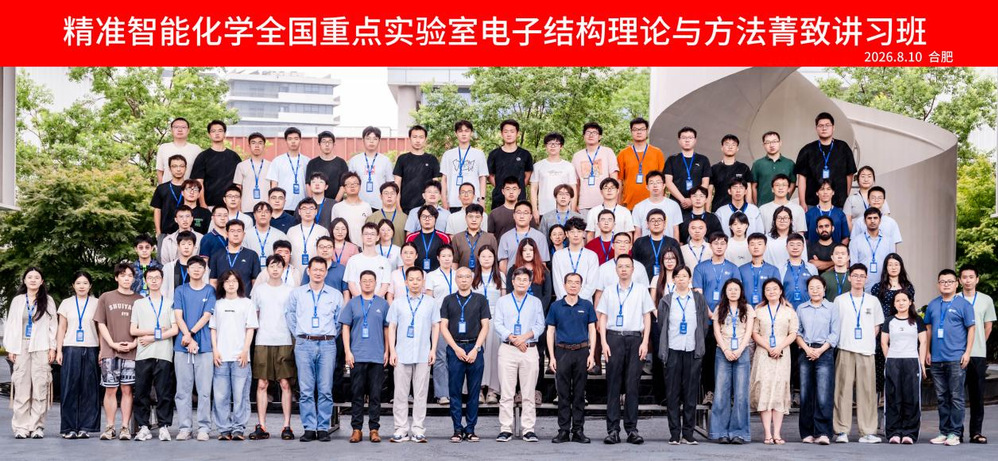
An opening ceremony was held on the morning of August 10. In his address, Professor Li Zhenyu, Director of the STATE KEY LABORATORY OF PRECISION AND INTELLIGENT CHEMISTRY, noted that electronic structure theory and methods have developed into a discipline with a clear hierarchy and a comprehensive framework. They provide critical tools for chemistry and materials science in addressing problems such as strongly correlated systems, excited states, and complex condensed phases. This workshop focused on electronic structure theory and methods—a foundational area shared by theoretical and computational chemistry, condensed matter physics, and materials science. It aimed to systematically introduce the disciplinary framework and recent advances in the field, help young scholars and graduate students gain deeper insight into this cutting-edge interdisciplinary domain, and attract more emerging talent to join related research endeavors.
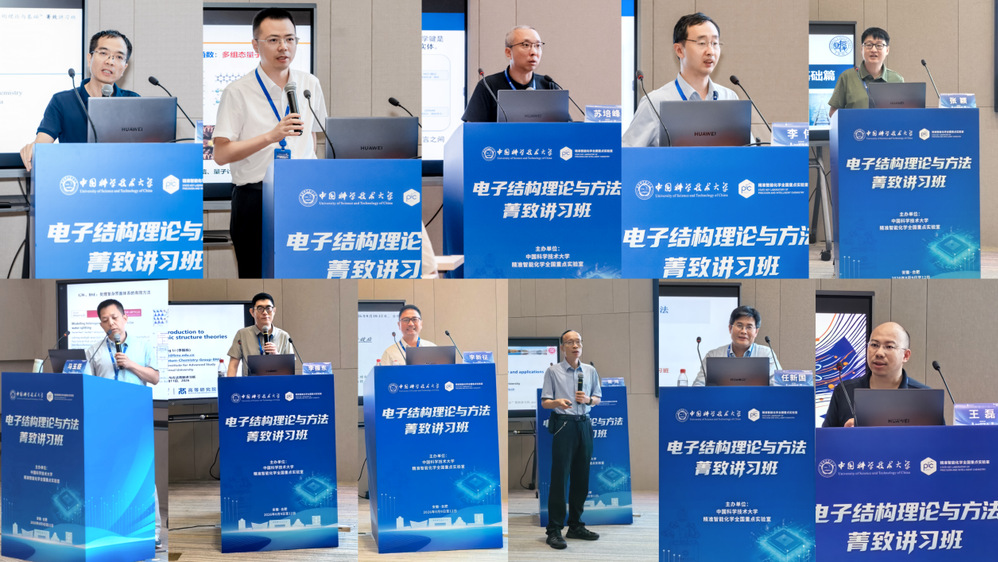
Over three intensive days of instruction, the experts delivered 22 theoretical lectures in succession. The curriculum closely tracked the latest developments in computational methods for electronic structures, both consolidating disciplinary fundamentals and pointing directly toward research frontiers.
In his course Fundamentals of Electronic Structure Theory, Professor Li Zhenyu began with the Hartree–Fock method and systematically introduced the formalism of second quantization, using it as a thread to outline the overall landscape of electronic structure calculations—from wavefunction methods such as configuration interaction and coupled cluster, to tools for handling strong correlations like density matrix renormalization group (DMRG), and to the important branch of density functional theory (DFT)—thus laying a common conceptual foundation for subsequent lectures. Professor Ma Haibo, in his course Density Matrix Renormalization Group Methods, started from Schmidt decomposition and low-rank matrix decomposition to introduce matrix product state representations and the basic principles of DMRG, with emphasis on the construction of matrix product operators, and demonstrated practical applications of DMRG using specific strongly correlated systems. Professor Su Peifeng, in Ab Initio Valence Bond Theory and Energy Decomposition Analysis, approached the nature of chemical bonds, elucidated how valence bond theory constructs wavefunctions through electron pairing, and combined energy decomposition analysis to reveal the physical picture of intermolecular interactions and chemical bond formation. Professor Li Wei, in Low-Scaling Electronic Structure Methods, focused on the core challenge of efficient computations for large systems and systematically introduced linear-scaling strategies, including various schemes based on localized orbitals, density matrix fragmentation, and energy fragmentation. Professor Zhang Ying, in Density Functional Theory and Double-Hybrid Functional Methods, began with wavefunction representations and exchange-correlation holes, derived in detail the Hohenberg–Kohn theorems and the Kohn–Sham equations, and, following the “Jacob’s ladder” hierarchy, presented the construction ideas and application scenarios of various exchange-correlation functionals. Professor Ma Yuchen, in Excited-State Electronic Structure Methods, centered on many-body Green’s function theory, provided a detailed derivation of the complete GW approximation framework, and introduced the Bethe–Salpeter equation to describe excitonic effects and optical spectra. Professor Li Zhendong, in Open-Shell Electronic Structure Methods, systematically taught the construction and derivation of spin eigenfunctions for open-shell systems, as well as the application of spin tensor operators in open-shell systems. Professor Li Xinzheng, in First-Principles Path Integrals and Nuclear Quantum Effects, systematically introduced the path-integral propagator method and explored in depth the specific applications of path-integral Monte Carlo and path-integral molecular dynamics in condensed-phase simulations. Researcher Jiang Hong, in Density Matrix Embedding Theory and Its Applications, introduced the embedding concept for strongly correlated systems and detailed the construction of density matrix embedding theory along with case studies in real materials calculations. Researcher Ren Xinguo, in First-Principles Methods for Condensed Matter, started from the many-electron Hamiltonian and systematically explained core concepts of solid-state physics such as Bloch’s theorem, and comprehensively introduced pseudopotential methods, plane-wave and LCAO basis sets, as well as applications of DFT in condensed matter systems. Researcher Wang Lei, in Machine Learning and Quantum Many-Body Computations, began with fundamental concepts of generative AI, introduced Bayesian inference and KL divergence, and, combined with autoregressive models, demonstrated cutting-edge applications of generative models in lattice structure design and quantum many-body problems.
Each lecture was followed by lively Q&A sessions, where participants actively posed questions and engaged in in-depth academic exchanges with the instructors.
The successful hosting of this Elite Workshop was not only a concentrated transmission of knowledge but also a profound dialogue within the academic community. At a time when computational science is increasingly interdisciplinary, a solid grasp of foundational methods and continuous expansion of frontier perspectives are becoming key pivots for young researchers to break new ground and innovate. This summer’s theoretical “forging” has undoubtedly planted seeds for more high-quality original achievements. The STATE KEY LABORATORY OF PRECISION AND INTELLIGENT CHEMISTRY will continue to promote its “Elite” series of high-quality academic exchange events, contributing to the cultivation of young talent and the advancement of disciplinary development.