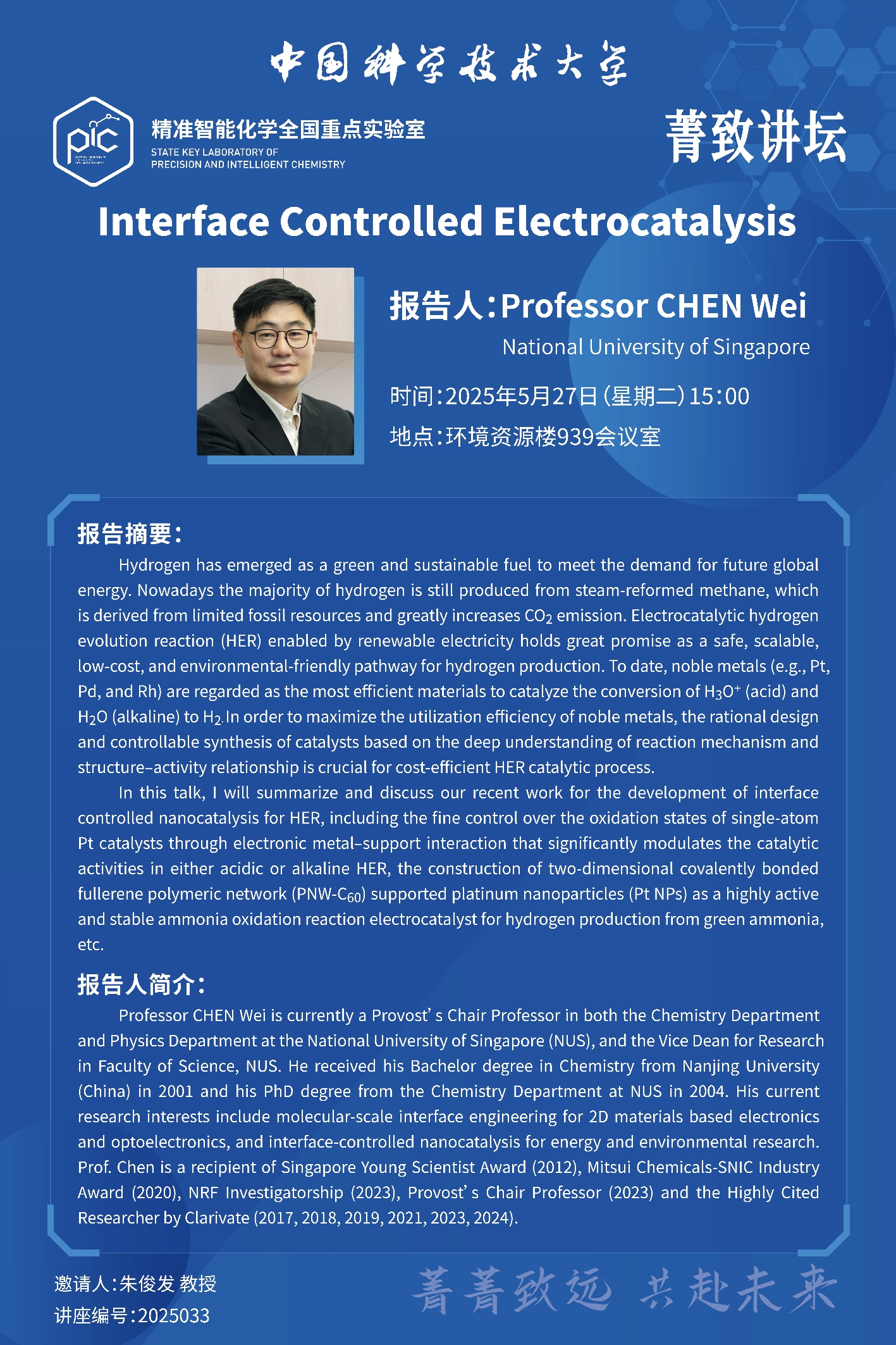

Report Title | Interface Controlled Electrocatalysis |
Reporter | Professor CHEN Wei |
Affiliation | National University of Singapore |
Time | 15:00, Tuesday, May 27, 2025 |
Location | Room 939, Environment and Resources Building,USTC |
Hosted by | State Key Laboratory of Precision and Intelligent Chemistry |
Abstract | Hydrogen has emerged as a green and sustainable fuel to meet the demand for future global energy. Nowadays the majority of hydrogen is still produced from steam-reformed methane, which is derived from limited fossil resources and greatly increases CO2 emission. Electrocatalytic hydrogen evolution reaction (HER) enabled by renewable electricity holds great promise as a safe, scalable, low-cost, and environmental-friendly pathway for hydrogen production. To date, noble metals (e.g., Pt, Pd, and Rh) are regarded as the most efficient materials to catalyze the conversion of H3O+ (acid) and H2O (alkaline) to H2. In order to maximize the utilization efficiency of noble metals, the rational design and controllable synthesis of catalysts based on the deep understanding of reaction mechanism and structure–activity relationship is crucial for cost-efficient HER catalytic process. In this talk, I will summarize and discuss our recent work for the development of interface controlled nanocatalysis for HER, including the fine control over the oxidation states of single-atom Pt catalysts through electronic metal–support interaction that significantly modulates the catalytic activities in either acidic or alkaline HER, the construction of two-dimensional covalently bonded fullerene polymeric network (PNW-C60) supported platinum nanoparticles (Pt NPs) as a highly active and stable ammonia oxidation reaction electrocatalyst for hydrogen production from green ammonia, etc. |
About the Reporter | Professor CHEN Wei is currently a Provost’s Chair Professor in both the Chemistry Department and Physics Department at the National University of Singapore (NUS), and the Vice Dean for Research in Faculty of Science, NUS. He received his Bachelor degree in Chemistry from Nanjing University (China) in 2001 and his PhD degree from the Chemistry Department at NUS in 2004. His current research interests include molecular-scale interface engineering for 2D materials based electronics and optoelectronics, and interface-controlled nanocatalysis for energy and environmental research. Prof. Chen is a recipient of Singapore Young Scientist Award (2012), Mitsui Chemicals-SNIC Industry Award (2020), NRF Investigatorship (2023), Provost’s Chair Professor (2023) and the Highly Cited Researcher by Clarivate (2017, 2018, 2019, 2021, 2023, 2024). |