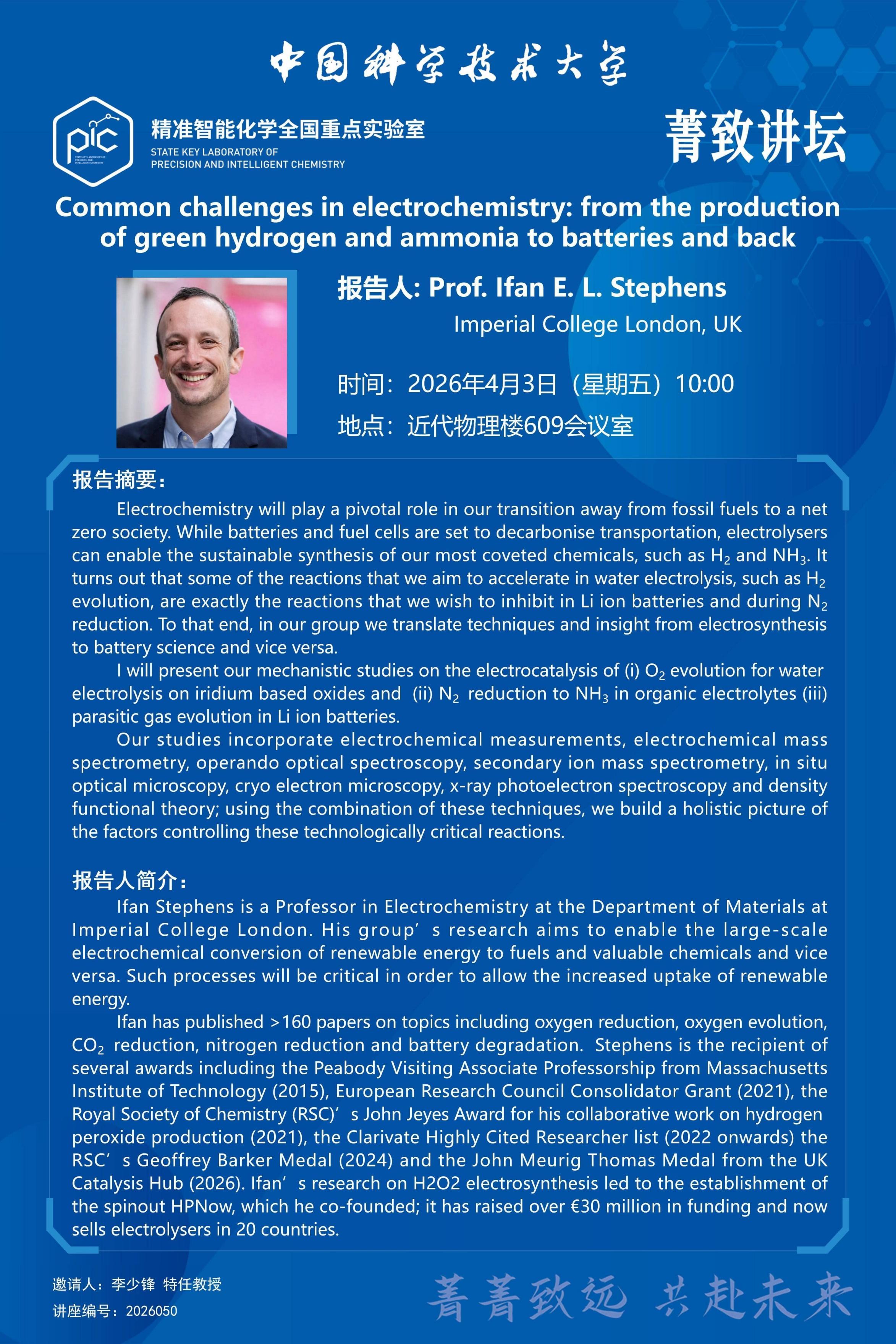

Report Title | Common challenges in electrochemistry: from the production of green hydrogen and ammonia to batteries and back |
Reporter | Prof. Ifan E. L. Stephens |
Affiliation | Imperial College London, UK |
Time | 10:00, Friday, April 3, 2026 |
Location | Room 609, Modern Physics Building,USTC |
Hosted by | State Key Laboratory of Precision and Intelligent Chemistry |
Abstract | Electrochemistry will play a pivotal role in our transition away from fossil fuels to a net zero society. While batteries and fuel cells are set to decarbonise transportation, electrolysers can enable the sustainable synthesis of our most coveted chemicals, such as H2 and NH3. It turns out that some of the reactions that we aim to accelerate in water electrolysis, such as H2evolution, are exactly the reactions that we wish to inhibit in Li ion batteries and during N2 reduction. To that end, in our group we translate techniques and insight from electrosynthesis to battery science and vice versa. I will present our mechanistic studies on the electrocatalysis of (i) O2 evolution for water electrolysis on iridium based oxides and (ii) N2 reduction to NH3 in organic electrolytes (iii) parasitic gas evolution in Li ion batteries. Our studies incorporate electrochemical measurements, electrochemical mass spectrometry, operando optical spectroscopy, secondary ion mass spectrometry, in situ optical microscopy, cryo electron microscopy, x-ray photoelectron spectroscopy and density functional theory; using the combination of these techniques, we build a holistic picture of the factors controlling these technologically critical reactions. |
About the Reporter | Ifan Stephens is a Professor in Electrochemistry at the Department of Materials at Imperial College London. His group’s research aims to enable the large-scale electrochemical conversion of renewable energy to fuels and valuable chemicals and vice versa. Such processes will be critical in order to allow the increased uptake of renewable energy. Ifan has published >160 papers on topics including oxygen reduction, oxygen evolution, CO2 reduction, nitrogen reduction and battery degradation. Stephens is the recipient of several awards including the Peabody Visiting Associate Professorship from Massachusetts Institute of Technology (2015), European Research Council Consolidator Grant (2021), the Royal Society of Chemistry (RSC)’s John Jeyes Award for his collaborative work on hydrogen peroxide production (2021), the Clarivate Highly Cited Researcher list (2022 onwards) the RSC’s Geoffrey Barker Medal (2024) and the John Meurig Thomas Medal from the UK Catalysis Hub (2026). Ifan’s research on H2O2 electrosynthesis led to the establishment of the spinout HPNow, which he co-founded; it has raised over €30 million in funding and now sells electrolysers in 20 countries. |