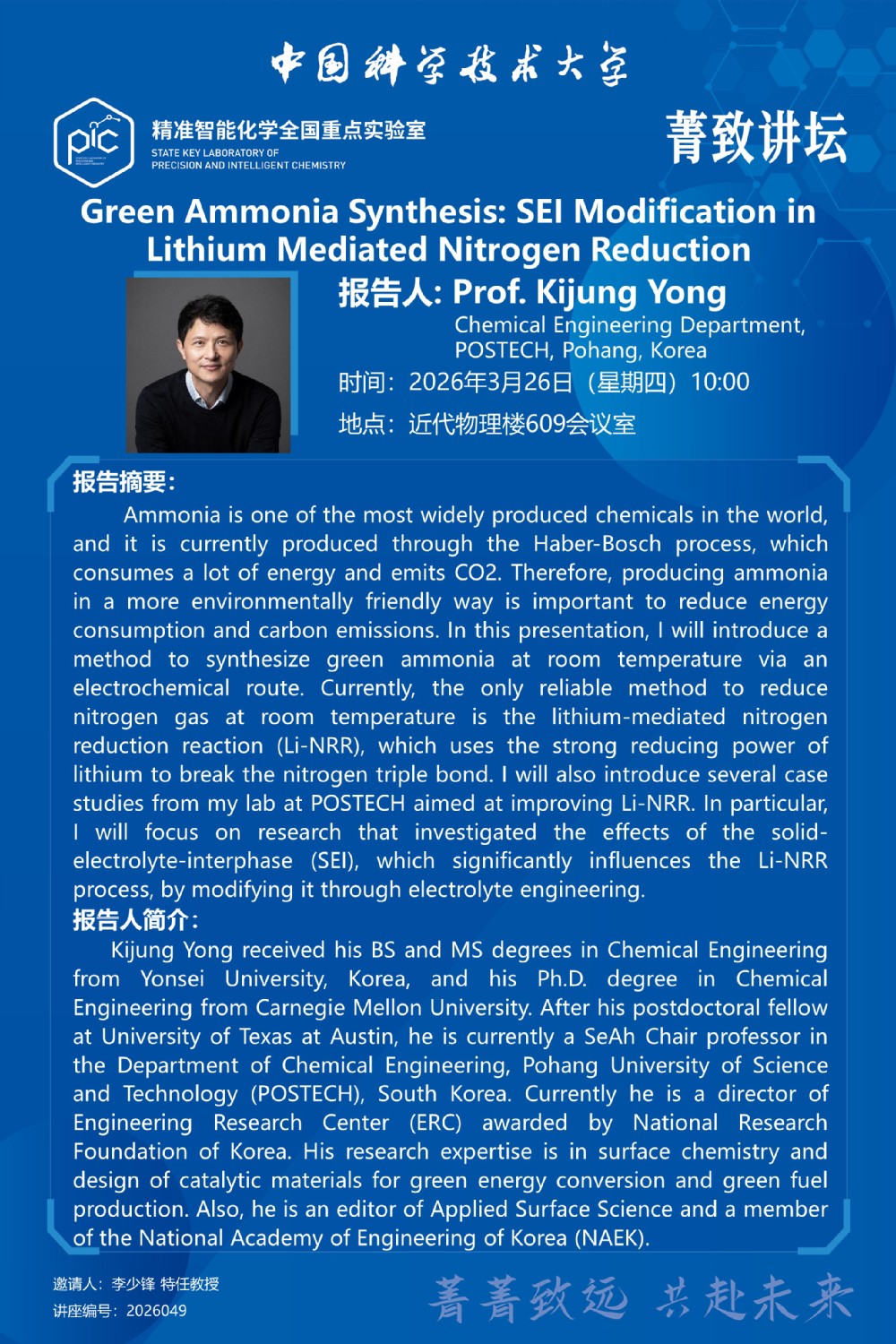

Report Title | Green Ammonia Synthesis: SEI Modification in Lithium Mediated Nitrogen Reduction |
Reporter | Prof. Kijung Yong |
Affiliation | Chemical Engineering Department, POSTECH, Pohang, Korea |
Time | 10:00, Thursday, March 26, 2026 |
Location | Room 609, Modern Physics Building,USTC |
Hosted by | State Key Laboratory of Precision and Intelligent Chemistry |
Abstract | Ammonia is one of the most widely produced chemicals in the world, and it is currently produced through the Haber-Bosch process, which consumes a lot of energy and emits CO2. Therefore, producing ammonia in a more environmentally friendly way is important to reduce energy consumption and carbon emissions. In this presentation, I will introduce a method to synthesize green ammonia at room temperature via an electrochemical route. Currently, the only reliable method to reduce nitrogen gas at room temperature is the lithium-mediated nitrogen reduction reaction (Li-NRR), which uses the strong reducing power of lithium to break the nitrogen triple bond. I will also introduce several case studies from my lab at POSTECH aimed at improving Li-NRR. In particular, I will focus on research that investigated the effects of the solid-electrolyte-interphase (SEI), which significantly influences the Li-NRR process, by modifying it through electrolyte engineering. |
About the Reporter | Kijung Yong received his BS and MS degrees in Chemical Engineering from Yonsei University, Korea, and his Ph.D. degree in Chemical Engineering from Carnegie Mellon University. After his postdoctoral fellow at University of Texas at Austin, he is currently a SeAh Chair professor in the Department of Chemical Engineering, Pohang University of Science and Technology (POSTECH), South Korea. Currently he is a director of Engineering Research Center (ERC) awarded by National Research Foundation of Korea. His research expertise is in surface chemistry and design of catalytic materials for green energy conversion and green fuel production. Also, he is an editor of Applied Surface Science and a member of the National Academy of Engineering of Korea (NAEK). |