

On May 16, 2025, scholars from the State Key Laboratory of Precision Intelligent Chemistry of the University of Science and Technology of China (USTC) visited the School of Science and the Advanced Materials Research Center at Xi’an Jiaotong-Liverpool University (XJTLU) to jointly host a symposium titled When Artificial Intelligence Meets Chemistry: XJTLU-USTC Joint Symposium on 'Artificial Intelligence Robot Chemist Research'. The event featured insightful presentations and in-depth discussions centered on innovations in artificial intelligence, chemistry, and materials science.
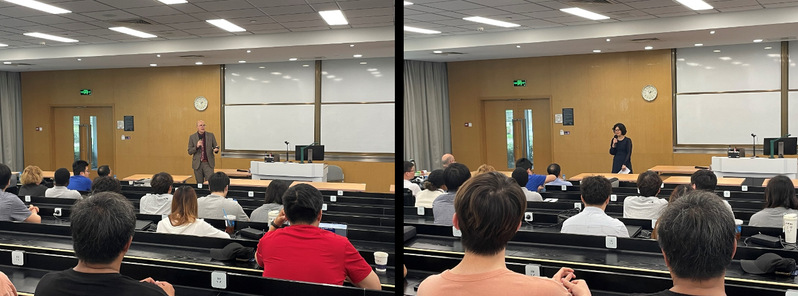
At the beginning of the event, Professor John Moraros, Dean of XJTLU School of Science, sincerely thanked the visiting guests of the State Key Laboratory of Precision Intelligent Chemistry of the University of Science and Technology of China and delivered the opening remarks for the symposium. I am honored to invite the industry-leading USTC team to XJTLU to carry out this research activity, said Professor John Moraros. This seminar is not only a communication between the two scientific research institutions on the achievements of related fields, but also looks ahead to the follow-up cooperation plan between the two sides. We will continue to carry out a series of exciting cooperative practices in the future, and we hope to achieve new developments and breakthroughs in chemical research in the era of digital intelligence through cooperation.
The moderator of the event, Professor Yang Li, Vice Dean of Research of XJTLU Polytechnic and Director of XJTLU Advanced Materials Research Center, delivered a speech. At a time when the development of digital intelligence is in full swing, the integration of artificial intelligence and robotics is gradually subverting the field of chemical research, promoting the development of autonomous experiments, data-driven discovery, intelligent decision-making, Professor Yang Li shared.
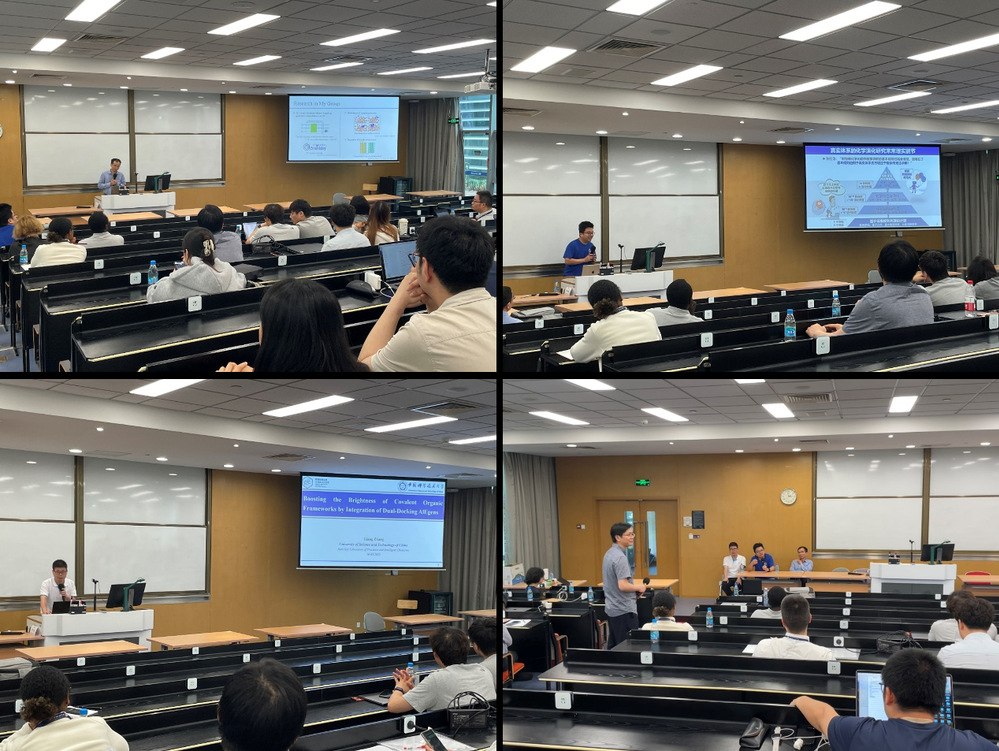
In the keynote speech session, Professor Li Zhenyu, Director of the State Key Laboratory of Precision Intelligent Chemistry of the University of Science and Technology of China, gave a wonderful sharing on the theme of Evaporation of Non-monomers in Molecular Clusters with Ring Remodeling Mechanism. Starting from the theoretical basis and experimental technology, he introduced in detail the research progress and achievements of the USTC team in the fields of computational chemistry, materials science, nanotechnology, etc., and put forward the prospects of optimization algorithms, new material development, environment-friendly applications and other directions and paths. In the Q&A session, Professor Li Zhenyu and the on-site questioners carried out impromptu exchanges and discussions on the issue of Stability of Molecular Clusters and Their Application Prospects, responded to the core of the questions from the aspects of thermodynamic stability, dynamic processes, and practical application scenarios, and pointed out the importance of interdisciplinary cooperation and technological innovation, which received warm applause from the audience.
Subsequently, Professor Chen Linjiang, Director of the Intelligent Chemistry Research Department of the State Key Laboratory of Precision Intelligent Chemistry of the University of Science and Technology of China, gave a sharing on the theme of Multi-agent, Multi-robot, Multi-task Autonomous Laboratory for On-demand Chemistry Research. He took the Machine Chemist 1.0 system as an example to vividly and humorously explain the development of chemical evolution research on real systems, gave an in-depth introduction and interpretation of independent experimental design, multi-task collaborative optimization, data closed-loop construction, etc., and shared in detail the advantages and characteristics of machine chemists driven by large model agents.
Dr. Zhang Liang, a special researcher at the State Key Laboratory of Precision Intelligent Chemistry of the University of Science and Technology of China, gave a presentation entitled Increasing Anchor Point Strategy for Enhancing the Fluorescence Properties of Covalent Organic Framework Materials. Starting from the background of the general lack of fluorescence properties of covalent organic framework (COFs) materials, he deeply analyzed the feasible path of fluorescence quenching in COFs materials from the principle of fluorescence quenching in COFs materials, and expounded the practical path of introducing AIE monomers with double anchor points in the framework to the fluorescence properties of materials through his own scientific research cases.
After the keynote speeches, the event came to the on-site interactive roundtable forum. Under the chairmanship of Ding Lifeng, Acting Director of the Department of Chemistry and Materials Science of XJTLU Polytechnic, the three sharing guests came to the podium together and interacted with the participants on artificial intelligence, chemistry and materials science innovation.
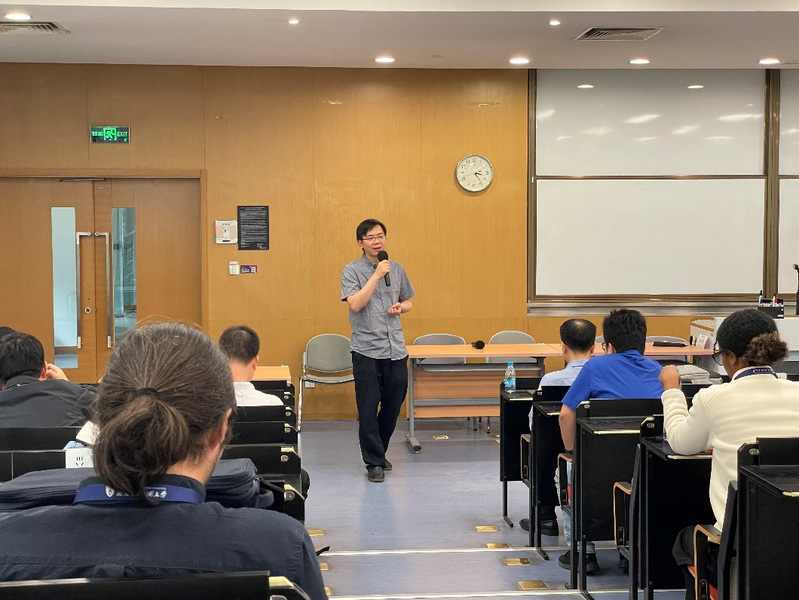
Topics such as the reliability of artificial intelligence in experimental design, how young scholars adapt to the paradigm shift of intelligent scientific research, and the challenges and paths of chemical research from laboratory to industrialization were further exchanged and discussed at the scene.
As the event came to an end, Dr. Ding Lifeng, Acting Director of the Department of Chemistry and Materials Science of XJTLU Polytechnic, delivered a concluding speech for the event. He said: XJTLU School of Science has not only officially started cooperation with the State Key Laboratory of Precision Intelligent Chemistry of the University of Science and Technology of China in the artificial intelligence robot chemist project, but also the robot chemist laboratory in XJTLU will be put into use soon. ”
He sincerely thanked all the experts and scholars from USTC, teachers and students who participated in the seminar, and looked forward to the future cooperation and development of XJTLU and USTC: Although the event has ended successfully, it is also an exciting beginning. Let’s look forward to the wonderful future that both parties will open up!”